Buying guides · Dog care & walking
Slow Feeder vs Regular Dog Bowl: Which One Makes Sense?
Compare slow-feeder and standard dog bowls, understand when a puzzle bowl helps, what materials to choose and when fast eating needs veterinary advice.

Your dog finishes dinner while you are still putting the scoop away. A slow feeder with ridges or channels looks like an obvious fix. Sometimes it is useful; sometimes it turns an ordinary meal into a difficult task.
A slow feeder is an enrichment and pacing tool, not a treatment for digestive disease. The correct choice depends on your dog's mouth shape, mobility, enthusiasm and how the bowl is maintained.
Slow feeder decision table
| Situation | Sensible starting point | What would make you stop |
|---|---|---|
| Eats calmly at a normal pace | Keep a stable regular bowl | No need to replace something working |
| Gulps meals but stays relaxed | Try a shallow slow-feeder pattern | Frantic pawing or chewing the feeder |
| Short muzzle or difficulty reaching food | Wide, shallow dish | Nose cannot reach food between ridges |
| Enjoys scent games | Try a simple supervised food puzzle | Frustration or loose pieces |
| Two dogs compete during meals | Separate feeding areas first | A dog steals food or intimidates another |
| Sudden vomiting, painful bloating or unproductive retching | Seek veterinary care urgently | Do not treat symptoms with a new bowl |
A feeder can alter meal pacing; it is not proven to prevent gastric dilatation-volvulus (GDV) or treat digestive illness.
The two options at a glance

Regular bowl: Easy to fill, usually easy to wash, and suitable for dogs that eat steadily. A broad base and sufficient capacity are important. Stainless steel is durable; heavy, unchipped ceramic can stay put on a smooth floor.
Slow feeder: Molded ridges, compartments or maze-like shapes make food slightly harder to reach. Some dogs enjoy the problem-solving element and take longer to finish. Others become frustrated, scratch at the bowl, or cannot reach food in narrow channels.
A standard food puzzle or scatter-feeding activity can sometimes provide enrichment without changing every meal.
When to consider a slow feeder
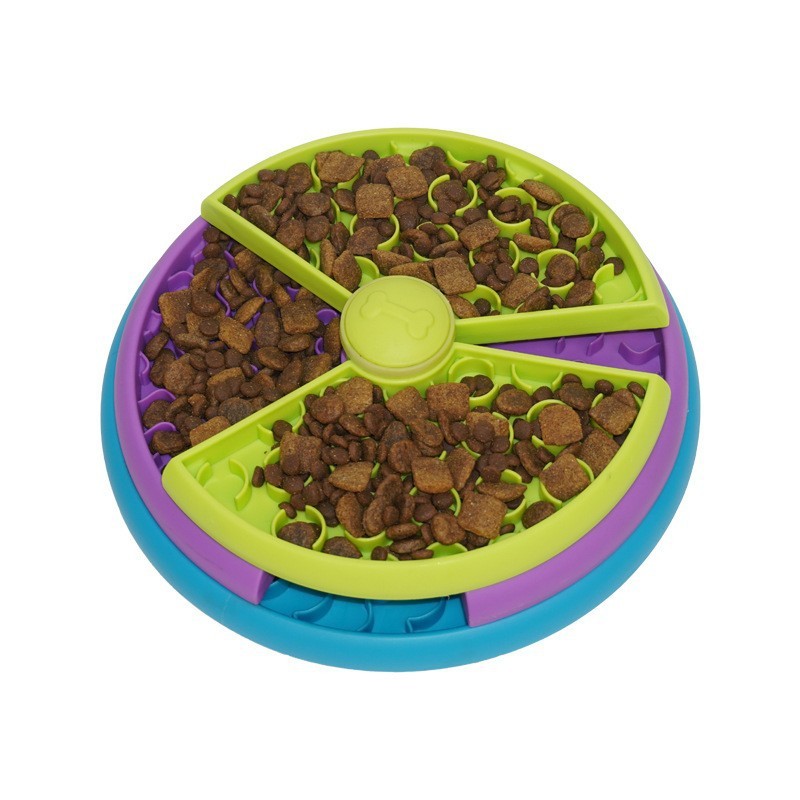
Example: Rotating Slow Feeder Puzzle Bowl. Design and availability may change.
Try one if your dog regularly gulps meals and stays relaxed while working around obstacles. Start with an easy pattern rather than the deepest maze. Put in a small meal portion, watch closely and compare how the dog eats. If eating becomes frantic or uncomfortable, stop.
Dogs with short muzzles, dental discomfort, impaired vision or reduced mobility may struggle with tall ridges. A shallow regular dish may be a kinder choice.
Do slow feeders prevent bloat?
Do not rely on that claim. Gastric dilatation-volvulus (GDV) is a life-threatening emergency, particularly relevant to some large, deep-chested breeds. No bowl should be advertised as a guaranteed way to prevent GDV. Discuss your dog's individual risk and prevention options with a veterinarian.
An unproductive attempt to vomit, swollen abdomen, severe restlessness, weakness or collapse requires immediate emergency veterinary attention.
Materials, shape and cleaning
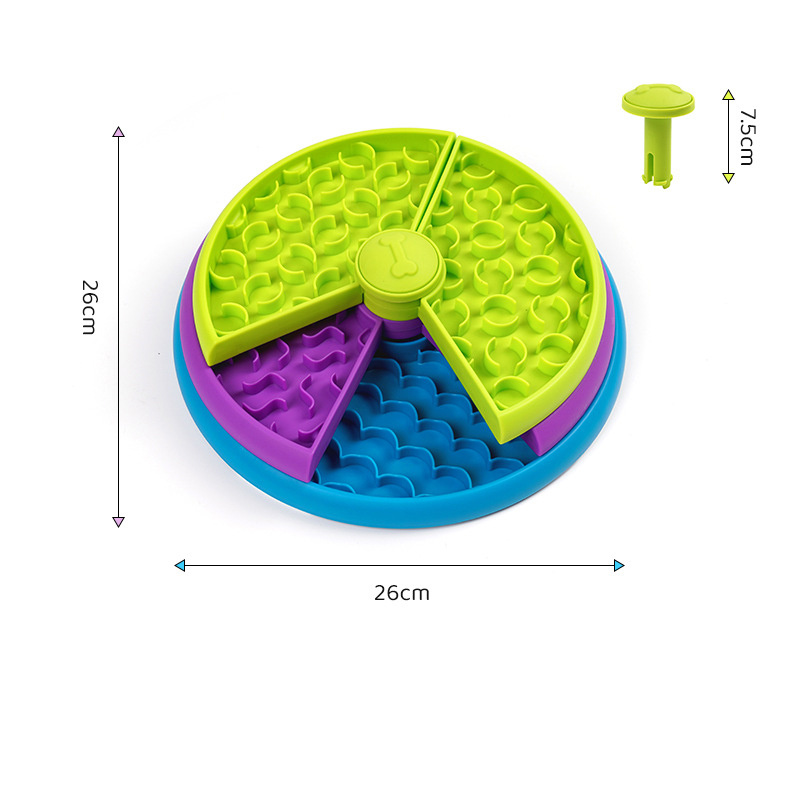
Example: 3-Layer Non-Slip Slow Feeder Bowl. This is a catalog photograph, not evidence of clinical efficacy.

- Stainless steel: Smooth surfaces are often easy to clean, but a complex insert still needs close inspection.
- Plastic puzzle bowls: Often lightweight, but check for food-safe materials, deep scratches, cracked ridges and a stable anti-slip base.
- Silicone inserts: Can make an existing bowl slower to use, but must fit securely. Remove if your dog tries to chew or swallow the insert.
- Ceramic: Stable and washable when undamaged, but fragile maze shapes may chip.
A bowl with narrow grooves that trap wet food is inconvenient and unhygienic, no matter how attractive it looks online. Choose a design you can reach with a sponge and dry completely.
A simple seven-day trial
Day 1: Time a normal meal without rushing your dog. Days 2–3: Offer a little food in an easy slow feeder under supervision. Days 4–6: Watch for changes in eating time, calmness, spilled food and cleaning effort. Day 7: Decide whether the setup improves daily life. There is no universal target number of minutes for a meal.
If the dog suddenly starts eating fast, seems unusually hungry, vomits repeatedly or loses weight, contact a veterinarian instead of assuming the bowl solves the problem.
Choosing the right size
Check usable food capacity, base diameter and channel width. The feeder must suit your dog's mouth and food type, and stay steady on the floor. For multi-dog households, feed separately so one dog cannot steal food or intimidate another.
Can I use wet food in a slow feeder?
Only when the manufacturer allows it and the bowl can be thoroughly cleaned. Never leave perishable food in the grooves.
Is a raised feeder better?
Not for every dog. There is no universally beneficial feeding height; discuss special medical needs with your vet.
Should I buy one for a puppy?
Introduce simple, supervised challenges and check the manufacturer's age guidance. A normal bowl is entirely acceptable.
For a short-muzzled dog, bowl access matters as much as eating speed. Read our French Bulldog slow-feeder fit and safety guide before selecting a deep maze.
What to record, and where the evidence comes from
During the seven-day comparison above, keep the same food portion and note meal duration, relaxed versus frantic behavior, remaining food, spills and cleaning time. A useful result is a manageable meal without distress, not an arbitrary number of minutes. If your dog chews the feeder, repeatedly cannot reach food or becomes anxious, return to the safer setup.
VCA Animal Hospitals describes slow-feeder bowls and food puzzles as ways to slow eating. Its environmental enrichment guidance emphasizes using challenges that suit the individual pet. For cleaning, the FDA recommends washing food bowls after every use.
How this guide was prepared: Kenio Editorial synthesized published recommendations into a decision checklist; it did not conduct a controlled product comparison or obtain a veterinary endorsement.
Related products
- Browse available pet feeding and water accessories — check sizes, construction and current availability before ordering.
Comments
No comments yet. Be the first to contribute.
Related stories
Pet care information is general guidance. Contact a veterinarian for health concerns.

Care guides · Dog care & walking
How to Choose a Slow Feeder for French Bulldogs
Choosing a slow feeder for a French Bulldog? Learn why shallow channels, stable bowls and easy muzzle access matter, plus safety signs to watch.
Read story →
Care guides · Dog care & walking
Why Your Dog Gives Up on Puzzle Toys (And How to Fix It)
Dog won't use a puzzle toy? Learn why dogs give up, how to spot frustration, make food puzzles easier, and choose sniffing alternatives.
Read story →