Care guides · Dog care & walking
Senior Dog Mobility at Home: 12 Ways to Help an Aging Dog
Help a senior dog move safely at home with non-slip floors, lifting harnesses, accessible beds, vet-backed tips and a practical mobility checklist.

When an older dog starts slipping on hardwood, hesitates before standing, or avoids stairs, look at where movement becomes difficult. Secure rugs along the route to the water bowl and door, make the resting area easy to enter, and record what happens when your dog rises and turns. New or worsening weakness needs a veterinary assessment; a lift harness or grippy sock can assist with a task, but cannot treat its cause. VCA's home-accessibility guide explains why traction and layout matter.
First: is your senior dog slowing down, or showing signs of pain?
A dog who is getting older may need a different pace, but difficulty rising is not automatically "just old age." Arthritis, injuries, neurological problems, and other medical conditions can affect mobility. VCA lists avoidance of slick surfaces, limping, difficulty rising, and hesitation at stairs or furniture among possible signs of pain in aging dogs.
Watch for these changes:
- Getting up slowly after a nap, then seeming a little more comfortable after moving.
- Scrambling or splaying the back feet on tile, laminate, or hardwood.
- Refusing stairs, the car, or a once-favorite couch.
- Turning awkwardly, standing with a changed posture, or favoring a leg.
- Sliding away from the food bowl or lying down to eat or drink.
- Becoming irritable when handled, reluctant to walk, or unusually quiet.
Arrange a veterinary appointment for new, persistent, or worsening mobility changes. Seek urgent veterinary care if your dog suddenly cannot stand, collapses, appears severely painful, drags limbs unexpectedly, or develops rapidly worsening weakness. Do not wait to see whether a new accessory fixes those signs.
Useful tip: Record a short video of your dog standing, turning, and walking on a normal surface. AAHA says home videos can help veterinarians evaluate movement and response to treatment. Never force a painful dog to repeat a movement for the video.
A quick senior-dog mobility home audit
Before buying anything, walk the same route your dog uses from bed to water bowl, from living room to the door, and from the door to the toilet area.
| What you notice | Change to make first | When an accessory may help |
|---|---|---|
| Feet slide on polished floors | Anchor non-slip runners along the entire walking route | Properly fitted grippy dog socks, if your dog accepts them |
| Dog struggles to stand | Put a secure mat next to the resting area; ask the vet why rising is difficult | A fitted rear-support lifting harness for supervised assistance |
| Dog avoids jumping onto a couch | Offer a comfortable floor-level bed; block unsafe jumping | A correctly sized, stable ramp, if appropriate |
| Dog has trouble settling | Provide a quiet, accessible resting spot with easy access | A low-entry cushioned bed or washable cushion |
| Dog has trouble on longer outings | Shorten the route and add rests; discuss exercise with the vet | A suitable walking harness or veterinarian-approved mobility aid |
| Dog struggles to reach the toilet area | Clear a predictable route and take more frequent breaks | Appropriately sized absorbent pads to protect a designated area |
Start with the floor and layout. That advice is consistent with VCA's guidance on a comfortable home for mobility-compromised dogs: reducing slips and preserving normal daily routines can make an important difference.
12 ways to support senior dog mobility at home
1. Ask your veterinarian to check the cause of new stiffness or weakness
An accessory is only one part of a plan. Your veterinarian can distinguish some orthopedic, neurological, or other causes of difficulty moving and discuss pain control, weight management, appropriate exercise, and rehabilitation. Cornell's osteoarthritis guide describes care as a combination of therapies—not a single gadget.
Bring videos, a description of the slippery rooms, and notes about how your dog handles stairs, eating, toileting, and walks. Do not give human pain medicine or change prescribed medication without veterinary advice.
2. Build one continuous non-slip path
Cover the most-used stretches of hardwood or tile with secure, washable runners or non-slip mats. Put traction next to the dog bed, feeding area, hallway turns, and exit door. Secure the edges so rugs do not bunch up or slide; loose mats can become another fall hazard.

Photo: Ron Lach / Pexels. Illustrates an accessible indoor resting area, not a veterinary mobility assessment.
An isolated mat under a water bowl does not replace a non-slip route across a room. This is one change many owners can make before purchasing pet-specific equipment.
3. Check nails and paw hair before blaming the floor
Overgrown nails can make comfortable footing more difficult for some dogs. Ask your veterinarian or groomer whether nail length and excess hair between paw pads are affecting traction. Trim gradually and avoid cutting the quick.
For owners who already know how to work safely, Kenio carries a rechargeable electric nail grinder for pets. It is a grooming tool, not an arthritis treatment. Introduce the sound slowly, use short sessions, and stop if the dog becomes distressed. See also how to clean dog paws after a walk.
4. Consider dog socks only if they actually improve grip
Some older dogs benefit from paw traction aids; others dislike wearing them or slip more if the fit is wrong. Start on a safe, supervised surface and check whether your dog can still spread the toes and place the foot normally.
Kenio's four-pack soft-soled dog socks with rubber soles is one possible option to evaluate. The current supplier description lists cotton-and-rubber construction but does not provide a dependable numerical size chart. Measure paws, check the available option details, supervise initial use, and stop if the socks rotate, bunch up, rub, or make walking less stable. Never assume a "non-slip" label guarantees safe traction on your own flooring.
5. Help with standing using properly fitted rear support
A dog who can move the front legs but struggles to rise or steady the hindquarters may benefit from brief, supported assistance, as advised by a veterinarian or rehabilitation professional.
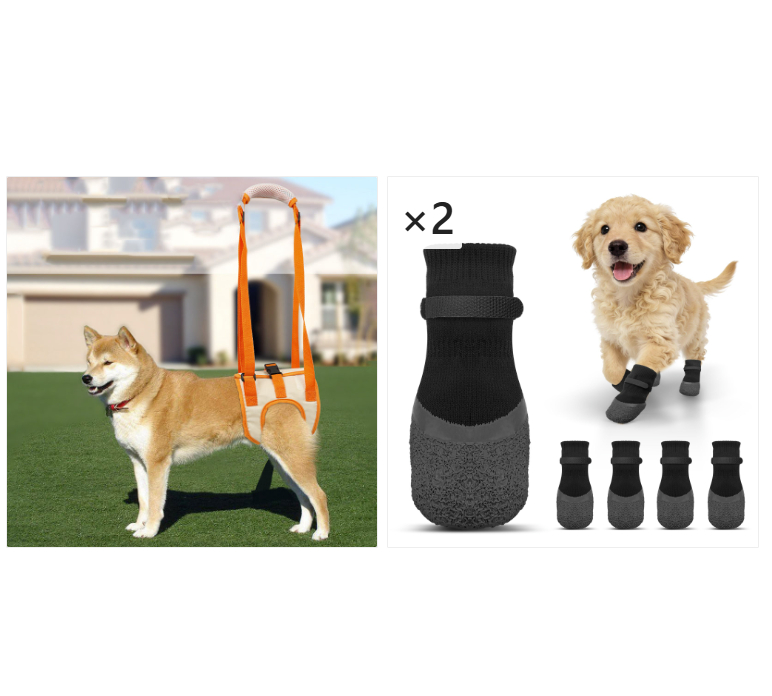
Product gallery image: Adjustable Rear-Leg Support Lift Harness for Senior Dogs. Supplier image; not proof of medical effectiveness or independently verified fit.
This rear-leg support lift harness is described as having mesh, a handle, closures, and listed size options. Check body measurements and the selected variant, and ask a professional to demonstrate safe support and handling if your dog is weak or painful. A rear sling should not be used to lift the dog's entire body off the ground unless the specific device and a veterinary professional explicitly support that use.
6. Reduce unnecessary stairs and jumping
If the dog can stay near the family on the main floor, put food, water, bedding, and access to outdoor breaks on that level. Use a gate where stairs are unsafe, rather than repeatedly encouraging an unstable dog to climb.
A ramp may help some dogs reach a low step, couch, or car, but its slope, grip, width, stability, and weight capacity matter. The American Kennel Club's senior-dog accessibility guide recommends considering these details. Not every dog can safely use stairs or a ramp.
7. Offer a steady resting place with an easy entrance
An older dog should not have to scramble onto a tall, unstable, or slippery bed. Choose enough room to stretch, a base that stays put, and an edge that the dog can cross comfortably.

Product gallery image: Non-Slip Bed for Dogs. Check the actual option's dimensions and raised-edge entry before choosing it for a dog with limited mobility.
Two existing Kenio options illustrate different trade-offs:
- Non-Slip Bed for Dogs: a corduroy sofa-style bed with a supplier-described non-slip base and padded sides; its raised edges may not work for every stiff dog.
- Washable Cotton-Filled Pet Bed Cushion: a simpler cushion-style rest area, but its listing does not document dependable measurements for every size or medical-grade orthopedic support.
Neither listing is verified as an orthopedic medical device. If your dog cannot get into a bed without effort, prioritize a lower, more accessible configuration over decorative padding. For general bed measurements, see how to choose a dog bed.
8. Keep water and food easy to reach
Place fresh water and the normal feeding station along a stable, short route. Put bowls on a surface that does not slip. Adjust their location before assuming your dog needs an elevated stand.
AAHA mentions bowl elevation as a possible environmental adjustment, but the right setup depends on the dog's condition and body shape. Ask your veterinarian before changing feeding height for a medical reason. Keep the dog's regular diet and prescribed feeding plan; mobility accessories do not replace appropriate weight and pain management.
9. Replace exhausting outings with manageable movement
An older dog often benefits from regular, tolerable, low-impact activity instead of one long, strenuous walk. The exact schedule depends on diagnoses, fitness, and your veterinarian's advice. Choose even surfaces, let your dog sniff, and watch for limping, reluctance, or fatigue.

Photo: Ajay Lamichhane / Pexels. A relaxed outdoor scene; not a therapeutic exercise demonstration.
For cold-season walking, the existing Kenio guide Winter Dog Paw Care covers ice, salt, and paw protection without repeating this mobility article.
10. Add mental enrichment that does not demand jumping or chasing
Mental stimulation need not mean running. A few hidden treats, slow sniffing, or a short supervised scent game can fit some older dogs' daily routines when their veterinarian has not restricted activity. Use treats that match the dog's diet and prevent large, awkward neck or body movements.
Kenio offers a 60 × 60 cm fleece nosework mat and an approximately 85 × 85 cm snuffle and training mat. Both are intended for supervised enrichment, not traction or rehabilitation. Remove the mat if the dog chews fabric or finds food searching frustrating. For more ideas, see easy nose-work games for dogs.
11. Make toilet breaks easier without ignoring new accidents
Provide a clear route to the preferred toilet area and more frequent opportunities to go out when needed. A low, secure, accessible space often matters more than making the dog walk farther.
For protecting a designated indoor area, Kenio has disposable absorbent pet training pads. This listing is for pads, despite a misleading supplier-style product name; the number of pads and dimensions vary by option. Pads manage cleanup, not the cause of incontinence. New or worsening accidents, straining, pain, or urinary changes require veterinary assessment.
12. Discuss wheels or specialized mobility aids with a professional
A mobility cart may be useful for some dogs with substantial limb impairment, but choosing one is not the same as selecting a bed. The frame must match the dog's measurements, movement pattern, balance, skin tolerance, and underlying medical condition.
Kenio currently lists a dog mobility wheelchair cart, but its saved product description lacks reliable adjustment dimensions and weight limits. We do not recommend ordering it based on the listing alone. Ask your veterinarian or canine rehabilitation provider whether a cart is appropriate, then verify full measurements and supplier specifications before considering purchase. A poorly fitted device can cause rubbing, falls, or further injury.
Which senior-dog accessories should you prioritize?
Do not purchase everything on the list. Match the tool to a problem you have actually observed.
| Primary problem | Priority | Possible Kenio item | Important limitation |
|---|---|---|---|
| Slipping on smooth flooring | Secure rugs or runners first | Rubber-soled dog socks | Only if measured fit improves traction |
| Trouble standing | Veterinary assessment and safe handling | Rear-leg lift harness | Support aid, not treatment |
| Resting is difficult | Accessible low-level rest area | Non-slip-base bed or washable cushion | Check entry height and dimensions |
| Claws affect foot placement | Nail evaluation and appropriate grooming | Electric nail grinder | Avoid the quick; not joint therapy |
| Less active but still curious | Gentle supervised enrichment | Nosework/snuffle mat | Not for dogs who ingest fabric |
| Longer route to toilet | Easier access and more breaks | Absorbent pads | Does not resolve incontinence |
| Major mobility impairment | Veterinary or rehabilitation assessment | Wheelchair cart, if properly specified | Current dimensions not documented |
Frequently asked questions
Why is my old dog slipping on hardwood floors?
Smooth floors give less grip, and a dog may also have pain, weakness, changes in posture, or paw/nail issues. Begin with a continuous, secured non-slip path, but ask a veterinarian to assess new or worsening slipping. Do not assume the flooring is the only cause.
Can a rear-leg harness help a dog with weak back legs?
A properly fitted rear-support harness may help a caregiver steady some dogs during assisted movement. It does not treat arthritis, nerve disease, or injury. The correct design and lifting technique depend on the dog's diagnosis and ability to bear weight.
Are ramps or stairs better for senior dogs?
Neither is universally safer. A stable, gentle, non-slip ramp can reduce some climbing demands, while even short stairs may be difficult for a dog with poor balance. Assess the dog's mobility and the actual ramp or step specifications; block unsafe access when necessary.
Are dog socks safe for older dogs?
They can be useful for some dogs but can also rotate, rub, trap moisture, or reduce traction when the size or sole is unsuitable. Try them only under supervision, with close attention to how your dog walks on the real floor.
Does a senior dog need an orthopedic bed?
Not every older dog needs a medically described orthopedic product. Accessible entry, a stable base, enough room, and comfortable support matter. A regular cushioned bed should not be advertised as orthopedic unless the manufacturer provides credible support for that claim.
When should I consider a dog wheelchair?
Only after a veterinary or rehabilitation assessment of substantial mobility impairment, and after obtaining an accurately measured and suitable cart. Unverified sizing and weight-limit information is a reason to pause a purchase.
Can exercise make my senior dog's arthritis worse?
The answer depends on the diagnosis, intensity, and the individual dog. Cornell includes low-impact activity in comprehensive osteoarthritis care, but painful or worsening movement warrants veterinary reassessment. Never force exercise through a limp or visible distress.
The bottom line: easier movement comes before more equipment
A senior-friendly home is not defined by how many accessories you buy. Start by preventing slips, shortening difficult routes, offering a comfortable low resting spot, and checking pain and mobility with your veterinarian. Then add carefully chosen aids only where they genuinely improve a task your dog needs to do.
A thoughtful combination of veterinary care, predictable routines, and suitable equipment may make ordinary days more comfortable. No accessory can promise to restore lost mobility, and products should never delay assessment of sudden weakness or significant pain.
Related Kenio care guides
- How to Choose a Dog Bed: Size, Support, and Cleaning
- How to Fit a Dog Harness Safely
- Winter Dog Paw Care: Salt, Snow, and Ice
- Easy Nose Work Games for Dogs
- 72-Hour Pet Emergency Kit
Veterinary references and image credits
- AAHA — 2023 Senior Care Guidelines: Pain Management — home mobility modifications, rugs, ramps, harnesses, beds, physical rehabilitation, and pain assessment.
- VCA Animal Hospitals — Creating a Comfortable Home for Your Mobility Compromised Dog — safer flooring, daily routines, and environmental changes.
- VCA Animal Hospitals — How to Recognize Pain in Aging Dogs — behavioral and movement signs that may indicate pain.
- Cornell University College of Veterinary Medicine — Osteoarthritis — evaluation and multimodal care including low-impact exercise, traction, and ramps.
- American Kennel Club — Senior Dog Home Accessibility — ramp and step selection considerations.
- Editorial photography: Harris Rigorad / Pexels (cover); Ron Lach / Pexels; Ajay Lamichhane / Pexels. Product images are taken from the associated Kenio supplier galleries.
Editorial disclosure: Kenio sells pet accessories. Product links show existing listings, not clinically tested treatments; ask your veterinarian about mobility aids and unexplained pain.
Comments
No comments yet. Be the first to contribute.
Related stories
Pet care information is general guidance. Contact a veterinarian for health concerns.

Care guides · Dog care & walking
72-Hour Pet Emergency Kit: Dog & Cat Go-Bag Checklist
Build a 72-hour pet emergency kit for dogs and cats. Get a practical go-bag checklist for storms, power outages and evacuations, plus CDC-backed tips.
Read story →
Buying guides · Dog care & walking
Best Reflective Gear for Walking a Black Dog at Night
Walking a black dog at night? Compare reflective harnesses, visible leashes, LED accessories and handler gear with practical safety checks.
Read story →
Care guides · Dog care & walking
Dog Boots Keep Falling Off? How to Measure Paws and Fix the Fit
Dog boots keep slipping or twisting? Measure front and back paws, troubleshoot straps and fit, and choose more suitable winter boots.
Read story →