Care guides · Dog care & walking
How to Travel Safely With Your Dog in a Car
A practical checklist for safer car journeys with dogs: secured crates, tested restraints, pickup and drop-off routines, breaks, heat and travel comfort.

Before driving with a dog, choose a securely fastened, vehicle-appropriate restraint or crate, then check where it sits in the car. A dog that stays calm on the seat is not necessarily protected during sudden braking. Keep heat, ventilation, and planned stops in mind; ordinary walking harnesses are not automatically crash-tested restraints.
Choose a secure restraint before you leave
A properly secured travel crate or a vehicle-compatible, crash-tested dog harness is preferable to riding loose. Check whether the product has credible independent crash-test information for your dog's weight and the vehicle. Follow installation instructions exactly; an ordinary walking harness is not automatically a crash-rated restraint.
Never attach a car safety tether to a neck collar. Sudden force can injure the neck. Don't allow dogs to sit on the driver's lap, wander near the pedals or travel in the front seat in front of an active airbag.
A loose crate can become a projectile. Secure the crate as directed by its manufacturer and verify that ventilation openings are not blocked.
Fit the equipment to your dog
For a crate, check that your dog can stand naturally, lie down and turn around in normal use, while remaining appropriately restrained for travel. The setup should not slide or collapse when the vehicle moves. For harness systems, look for suitable sizing, strong attachment points, and a clear record of safety testing; marketing phrases alone are not proof.
If a dog has arthritis or difficulty jumping, consider a stable ramp or assisted entry rather than making every journey a painful leap.
Practice with short, positive journeys

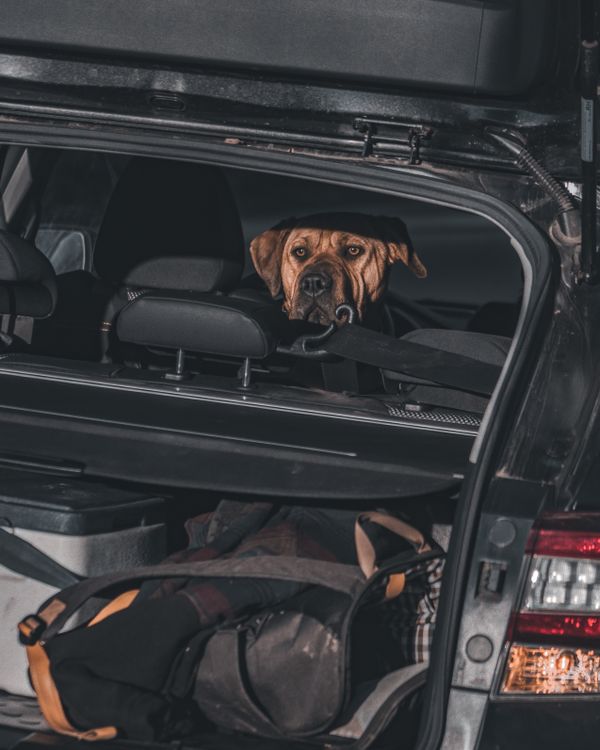
Photo: valentina lopez / Unsplash.
Start with the engine off and let your dog explore the secured setup while receiving calm praise or rewards. Move to very short drives, then gradually increase duration. A walk or another pleasant activity after the trip can help build a positive association. Do not force a panicking dog into longer journeys; ask a veterinarian or qualified behavior professional for help.
Motion sickness, drooling, repeated yawning, vomiting or persistent distress deserve attention. A veterinarian can discuss safe strategies and appropriate medication when needed.
Before the door closes
- Attach the restraint and check it cannot reach the driver's area.
- Pack water, a bowl, waste bags, cleaning supplies and any prescribed medications.
- Ensure your dog wears identification and that contact information is current.
- Plan stops for toileting and water on longer trips.
- Bring the dog's familiar bedding if it does not interfere with harness or crate safety.
Keep windows appropriately closed or only minimally opened; don't let a dog hang its head outside. Flying debris and sudden stops can cause injuries.
Loading and unloading without escapes
Park in a safe place away from traffic. Put a leash on your dog before opening the door or crate. Use the pavement-side door where practical. One person should control the dog while another handles bags and doors if the situation is busy.
On arrival, let your dog settle before being released into an unfamiliar space. Do not assume the parking lot is secure.
Heat safety is nonnegotiable
Never leave a dog alone in a parked car. Cabin temperatures can rise quickly even when the weather feels mild or a window is cracked. Air conditioning can fail. Plan stops where your dog is allowed to accompany you; if this is impossible, arrange another safe plan.
Seat covers (not crash-tested restraints)
- Browse available pet travel accessories — check sizes, construction and current availability before ordering.
Common questions
Is a back-seat dog hammock enough?
A hammock can protect upholstery but is not by itself a crash restraint. Your dog still needs an appropriate secured system.
Can my dog ride in a pickup bed?
An open cargo bed creates serious injury and escape hazards. Transport the dog securely inside a suitable vehicle instead.
How often should we stop?
The answer varies by age, health and journey conditions. Offer reasonable breaks, monitor comfort and follow veterinary advice for puppies or dogs with medical needs.
For everyday walking before and after a drive, review our dog harness fit guide and remember that a road harness and crash-tested vehicle restraint may have different requirements.
Further reading and safety guidance
Comments
No comments yet. Be the first to contribute.
Related stories
Pet care information is general guidance. Contact a veterinarian for health concerns.

Care guides · Dog care & walking
Senior Dog Mobility at Home: 12 Ways to Help an Aging Dog
Help a senior dog move safely at home with non-slip floors, lifting harnesses, accessible beds, vet-backed tips and a practical mobility checklist.
Read story →
Care guides · Dog care & walking
72-Hour Pet Emergency Kit: Dog & Cat Go-Bag Checklist
Build a 72-hour pet emergency kit for dogs and cats. Get a practical go-bag checklist for storms, power outages and evacuations, plus CDC-backed tips.
Read story →
Buying guides · Dog care & walking
Best Reflective Gear for Walking a Black Dog at Night
Walking a black dog at night? Compare reflective harnesses, visible leashes, LED accessories and handler gear with practical safety checks.
Read story →